作者: Vocab Team
最后更新:
英语介词 in、on、at 用法:地点表达不再混淆
用 Vocab 开始积累真正用得上的英语词汇
免费下载。用间隔重复、主题词表和母语者发音学得更快,也把学过的词真正记住。
地点介词 in、on、at:先掌握一个清楚的判断方法
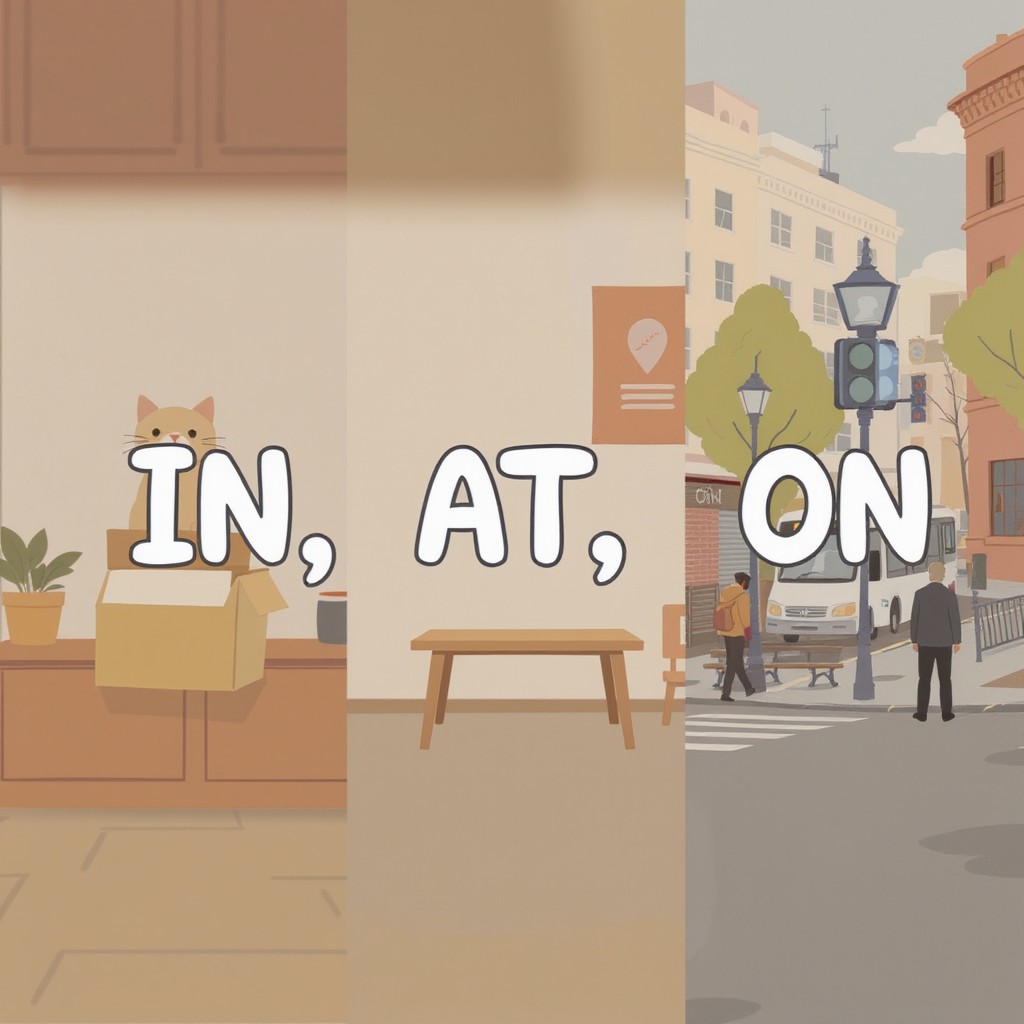
说地点时,in、on、at 都可能译成“在”,但英语在意的是你怎样看待这个地点:把它看成内部空间、一个表面,还是地图上的一个点。
这篇课文只讲地点用法。学完后,你可以用三个问题判断:
- 人或物是在一个有边界的空间里面吗?用 in。
- 人或物是接触某个表面吗?用 on。
- 只是说明人在某个地点、场所或活动点吗?用 at。
这个方法很有用,但有些地点会因说话重点不同而改变介词。后面会用对比例句说明。
in:在空间、区域或容器内部
in 强调“在里面”。这个空间可以很小,例如盒子;也可以很大,例如城市或国家。
- The keys are in my bag. 钥匙在我的包里。包像一个容器,所以用 in。
- She is in the kitchen. 她在厨房里。重点是她已在房间内部。
- We live in Shanghai. 我们住在上海。城市被看作一个区域。
- There is a cat in the garden. 花园里有一只猫。这里把花园看作有范围的空间。
- I saw the address in the email. 我在邮件内容里看到了这个地址。信息位于邮件内容中,也用 in。
in 常见地点搭配
- in a room:在房间里
- in a building:在建筑物里
- in a city:在城市里
- in a country:在国家里
- in a box:在盒子里
- in a car:在小汽车里
in a car 很常见,因为汽车通常被看作小而封闭的内部空间。
- I left my phone in the car. 我把手机落在车里了。
on:在表面上,或在某些交通工具上
on 最基本的意思是“在表面上”,通常表示接触一个平面或表层。墙是垂直的,也一样可以用 on。
- Your cup is on the table. 你的杯子在桌子上。
- There is a picture on the wall. 墙上有一幅画。
- The children are sitting on the floor. 孩子们坐在地板上。
- Write your name on the form. 请把名字写在表格上。
- I found the news on the internet. 我在网上看到这条消息。
on 用于公共交通工具
大型公共交通工具常用 on,即使你实际上在车厢内部。英语把人视为“在这趟交通工具上”。
- She is on the bus. 她在公交车上。
- We met on the train. 我们在火车上认识。
- He fell asleep on the plane. 他在飞机上睡着了。
也要注意:on a bike 表示骑自行车,on a motorcycle 表示骑摩托车。人坐在车辆上方或外部位置,因此用 on。
- They came here on bikes. 他们骑自行车来这里。
on 常见地点搭配
- on the table:在桌上
- on the wall:在墙上
- on the floor:在地板上
- on the page:在页面上
- on the second floor:在二楼
- on the bus:在公交车上
- on the street:在街上
at:在一个具体地点、场所或活动点
at 把地点看作一个点。它通常不强调你在建筑物里面、门外还是楼上,而是强调你出现在那个地方,或正在参加那里发生的活动。
- I am at the bus stop. 我在公交车站。
- Meet me at the entrance. 在入口处见我。
- She is at work. 她在上班,或她在工作场所。
- They are at a concert. 他们在音乐会上。
- We arrived at the airport early. 我们很早就到了机场。
- He lives at 18 Green Street. 他住在绿街 18 号。完整门牌地址前用 at。
at 常见地点搭配
- at home:在家
- at school:在学校,常强调上学或学校这一场所
- at work:在工作场所或上班
- at the door:在门口
- at the station:在车站
- at the airport:在机场
- at a party:在聚会上
at home 是固定说法,不说 in home。如果要说“在某人家里”,可说 in my house 或 at my house,两者的重点不同。
同一个地方,为什么介词会变?
地点本身不一定决定介词。更重要的是你要表达的角度。
at the café 和 in the café
- I am at the café. 我在咖啡馆,重点是我人在这个约定地点,可能在里面,也可能在门外等人。
- I am in the café. 我在咖啡馆里面,重点是室内位置。
如果朋友问你在哪里,两句都可能自然。若要特别说明“我已经进店了”,选 in 更清楚。
at the school 和 in the school
- My dad is at the school. 我爸爸在学校,重点是他到了学校这个地点,可能是接人或开会。
- My dad is in the school. 我爸爸在学校建筑物里面。
这里的 the 也很重要。at school 常表示上学或在学校这一日常状态;at the school 更像指某一所具体学校。
at the door 和 in the room
- Someone is at the door. 有人在门口。此人可能还在门外。
- Someone is in the room. 有人在房间里。此人已经处于室内。
on the street 和 in the street
- There are many cafés on this street. 这条街上有很多咖啡馆。指沿街分布的店铺。
- A child is playing in the street. 一个孩子正在马路上玩。通常指车道区域,因此常带有危险或警告的语气。
in a car 和 on a bus
- Wait for me in the car. 在车里等我。
- I left my umbrella on the bus. 我把伞忘在公交车上了。
不要只按“是否能走动”来背。把 in a car 和 on a bus/train/plane 当作高频搭配记住,会更可靠。
容易犯的错误
不要把所有“在”都翻成 in
- 不自然:My book is in the table.
- 自然:My book is on the table.
书接触桌面,不是在桌子内部,所以用 on。
不要在完整地址前用 in
- 不自然:She lives in 25 King Road.
- 自然:She lives at 25 King Road.
带具体门牌号的地址被看作一个精确点,通常用 at。
不要把 at 当成“建筑物里面”
- He is at the library. 他在图书馆这个地点。
- He is in the library. 他在图书馆建筑物里面。
两句不一定互相矛盾。第一句回答“他在哪里”,第二句更具体说明“他在室内”。
一张速记图
- in:内部空间或区域,例如 in a box、in Beijing、in a car。
- on:表面、媒介或特定交通工具,例如 on the wall、on the internet、on a train。
- at:地点点位、活动或完整地址,例如 at the station、at a party、at 18 Green Street。
遇到地点名时,先不要急着逐字翻译。先问自己:我是在说“里面”“表面”,还是只是在标出一个地点?
练习:选择 in、on 或 at
在每个空格填入 in、on 或 at。
- My sister is waiting ___ the station.
- There is a note ___ the fridge door.
- We stayed ___ a small hotel near the beach.
- I met an old friend ___ the train.
- Please leave your shoes ___ the box.
- The manager is ___ a meeting.
- They live ___ 42 River Road.
- There are two people ___ the photo.
答案与解析
- at。at the station 把车站看作约定或停留的地点。
- on。纸条贴在冰箱门的表面上。
- in。住在旅馆的建筑物内部,用 in a hotel。
- on。火车属于常用 on 的公共交通工具。
- in。鞋子放进盒子内部。
- at。at a meeting 表示在参加会议这一活动。
- at。完整门牌地址前用 at。
- in。人物位于照片内容中,用 in the photo。
用一句话巩固
把 in 想成“里面”,把 on 想成“接触表面或在交通工具上”,把 at 想成“一个地点或活动点”。先用这个核心逻辑判断,再逐渐积累固定搭配,你会越来越自然地选择正确的地点介词。